Benefits, Prices and How to Choose the Right System
Access to clean, safe drinking water is essential for households, businesses, and institutions. In Kenya, water quality can vary depending on the source, making appropriate water treatment an important consideration for anyone looking to supply quality drinking water.
Reverse osmosis water purifiers in Kenya are increasingly relevant to entrepreneurs, water vending businesses, bottled water producers, schools, hospitals, hotels, and commercial establishments seeking effective water treatment solutions.
At Mavada Technologies, we help businesses explore water purification equipment suited to their water quality, production capacity, and operational requirements.
What Is a Reverse Osmosis Water Purifier?
A reverse osmosis (RO) water purifier is a water treatment system that uses pressure to push water through a semipermeable membrane. The membrane separates water from many dissolved substances and contaminants, allowing treated water to pass through while concentrating rejected substances in a separate stream.
Depending on the system design and source water, reverse osmosis can reduce dissolved salts, certain metals, and other contaminants.
RO systems are commonly used for:
- Drinking water purification
- Water vending stations
- Commercial water refilling businesses
- Bottled drinking water production
- Hotels and restaurants
- Schools and hospitals
- Industrial and commercial water treatment
The right system depends on the quality of the incoming water and the intended application.
How Does Reverse Osmosis Work?
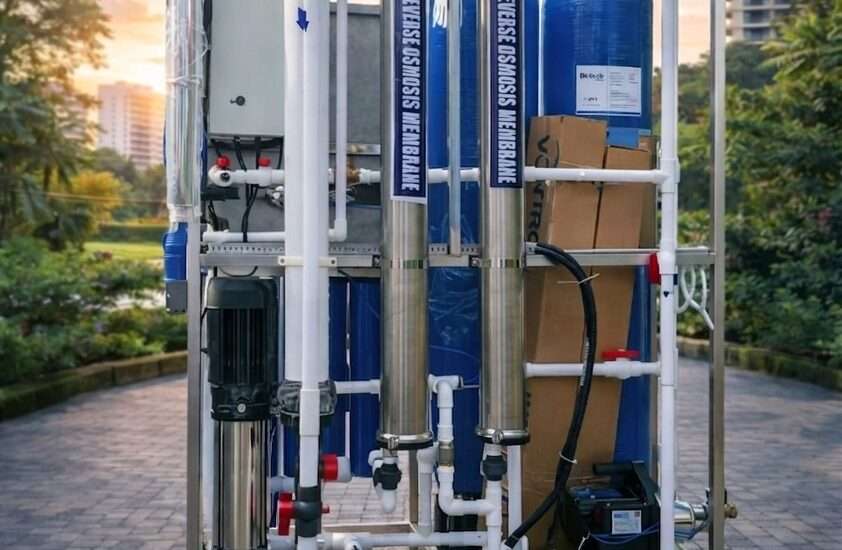
A typical reverse osmosis system may include several treatment stages.
1. Sediment Filtration
The sediment filter helps remove suspended particles such as sand, rust, and other physical impurities that could interfere with downstream treatment.
2. Activated Carbon Filtration
Carbon filtration can reduce chlorine and certain organic compounds that affect taste and odour. It can also help protect chlorine-sensitive RO membranes.
3. High-Pressure Pump
The pump supplies the pressure needed to push water through the RO membrane. The required pressure depends on factors such as feed-water salinity, temperature, and the membrane specification.
4. Reverse Osmosis Membrane
The membrane is the central component of the system. It reduces many dissolved substances and contaminants, producing permeate water and a concentrated reject stream.
5. Post-Treatment
Depending on the application, the system may include UV disinfection, remineralization, or other polishing stages. The treatment configuration should be selected according to the source-water assessment and the required final water quality.
Benefits of Reverse Osmosis Water Purifiers
1. Reduction of Dissolved Salts
RO systems can reduce many dissolved salts, making them useful for treating water with elevated salinity or total dissolved solids (TDS).
2. Improved Water Taste
By reducing certain dissolved substances and other taste-affecting compounds, a properly designed system may improve the taste of drinking water.
3. Flexible Applications
RO technology can be configured for domestic, commercial, and industrial use. System capacities range from small household units to large plants processing thousands of litres per hour.
4. Support for Water Vending Businesses
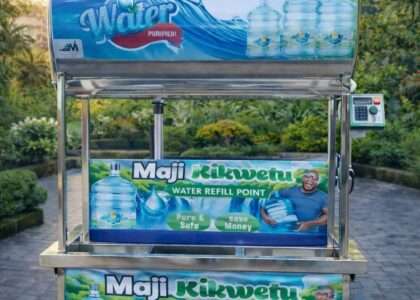
For entrepreneurs operating water refilling stations, an appropriately designed RO system can form part of a complete water treatment setup.
The plant should be sized according to expected sales, available source water, storage requirements, and operating hours.
5. Customizable Treatment
RO can be combined with pretreatment and post-treatment technologies to address the specific characteristics of the source water.
Important: Reverse osmosis is not a substitute for water testing. The correct treatment process should be selected based on laboratory results and applicable drinking-water requirements.
Reverse Osmosis Water Purifier Prices in Kenya
The price of an RO water purifier in Kenya depends on its capacity, construction, automation, membrane configuration, pretreatment requirements, and installation needs.
Common factors affecting the cost include:
- Production capacity in litres per hour (LPH)
- Number and type of RO membranes
- Feed-water quality
- Pumps and electrical controls
- Pretreatment filters and vessels
- Storage tanks and dispensing equipment
- Installation and plumbing
- Warranty, servicing, and spare parts
A small domestic purifier has very different requirements from a commercial plant intended to supply a water vending business.
Before purchasing, request a quotation that clearly specifies the system’s rated capacity, expected recovery, included components, installation requirements, and maintenance costs.
Contact Mavada Technologies to discuss the appropriate system for your needs.
Choosing the Right RO System Capacity
Selecting the right capacity is important for ensuring that your water treatment system can meet demand without unnecessary expenditure.
Small Domestic RO Systems
These are designed for household drinking-water applications. Selection depends on daily water consumption, available water pressure, and source-water characteristics.
Commercial RO Systems
Commercial systems may be suitable for restaurants, offices, schools, hotels, and small water refilling operations.
The required capacity depends on daily consumption, peak demand, and available storage.
Industrial RO Plants
Larger RO plants are designed for high-volume applications, including commercial water production and industrial processes.
Their design may require detailed water analysis, pretreatment, chemical dosing, automated controls, and engineered storage and distribution systems.
When choosing a system, distinguish between the manufacturer’s rated production capacity and the actual output expected under your operating conditions.
Starting a Water Vending Business with an RO Purifier
A water vending business can be an opportunity for entrepreneurs in Kenya, but profitability depends on location, customer demand, water quality, pricing, and operating expenses.
If you intend to establish a water refilling station, consider the following steps.
Step 1: Research your market. Identify your target customers, nearby competitors, local prices, and expected daily demand.
Step 2: Test your source water. Obtain an appropriate laboratory analysis to determine the treatment required.
Step 3: Select the right RO capacity. Estimate daily production needs and allow for periods of peak demand.
Step 4: Plan your complete setup. Consider pretreatment, RO equipment, storage tanks, filling stations, plumbing, electrical requirements, and any necessary disinfection stages.
Step 5: Budget for running costs. Include water supply, electricity, replacement filters, membranes, cleaning, maintenance, rent, staff, packaging, and delivery.
Step 6: Confirm regulatory requirements. Consult the relevant Kenyan authorities and county government regarding water quality, public health, business permits, and any applicable approvals for drinking-water production and sale.
Reverse Osmosis vs Ultrafiltration
RO and ultrafiltration (UF) are different technologies, and choosing between them depends on the water being treated.
| Feature | Reverse osmosis | Ultrafiltration |
|---|---|---|
| Membrane function | Reduces many dissolved salts and contaminants | Primarily removes suspended particles and many microorganisms |
| Dissolved salts | Removes a substantial proportion of many dissolved salts | Generally allows dissolved salts to pass through |
| Common applications | Saline water treatment and drinking-water purification | Particle and microorganism removal, often as pretreatment or part of a treatment train |
| Waste stream | Produces a concentrated reject stream | Often uses backwashing; waste depends on system design |
| Best choice | Depends on source-water chemistry and required water quality | Depends on particle and microorganism risks and required water quality |
Neither technology should be selected based on price alone. A water-quality assessment will help determine whether RO, UF, or a combination of treatment processes is appropriate.
Maintenance of Reverse Osmosis Water Purifiers
Regular maintenance helps maintain system performance and protect the membrane.
Key maintenance practices include:
- Replacing pretreatment filters at the recommended intervals
- Monitoring feed-water pressure and RO operating pressure
- Checking permeate flow and water quality
- Monitoring membrane performance and salt rejection
- Cleaning or replacing membranes when indicated
- Inspecting pumps, valves, and pipework for leaks
- Sanitizing storage tanks and downstream equipment as required
- Keeping service and water-quality records
Maintenance schedules should reflect actual operating conditions and the manufacturer’s instructions.
Why Choose Mavada Technologies for RO Water Purification Equipment?
Mavada Technologies helps businesses explore water purification solutions based on their needs, expected output, and intended application.
Whether you need an RO purifier for a water vending station, a commercial establishment, or a larger water treatment operation, choosing the right configuration is essential.
We encourage customers to consider source-water quality, required production capacity, installation needs, maintenance support, and long-term operating costs before investing.
Get the Right Reverse Osmosis Water Purifier for Your Business
Reverse osmosis can be an effective component of a properly designed water treatment system. However, successful water purification requires more than purchasing a machine: it also involves water testing, correct system sizing, hygienic handling, maintenance, and compliance with applicable standards.
If you are looking for *reverse osmosis water purifiers in Kenya, contact *Mavada Technologies to discuss your source water, required capacity, and water treatment objectives.
Mavada Technologies — explore practical water purification solutions for your home, business, or institution.